
A B O U T
Alessandria
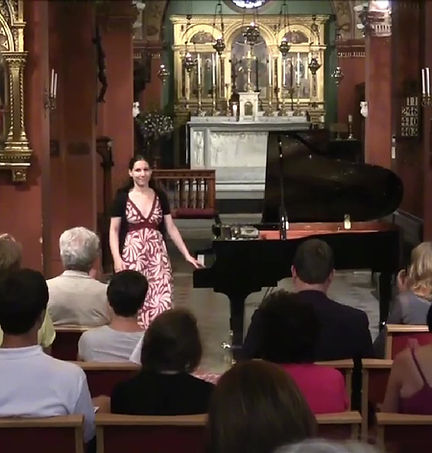
Looking back, I realise that the most important decisions in my life were never driven solely by ambition or careful planning. They began with a quiet intuition—one that only revealed its meaning much later.
I was born and raised in Montréal, Canada, where I began my musical education before completing a Bachelor’s Degree in Piano Performance and Musical Arts at McGill University under the guidance of the Georgian pianist Marina Mdivani, an internationally acclaimed concert pianist, prizewinner of both the Marguerite Long–Jacques Thibaud Competition in Paris and the Tchaikovsky Competition in Moscow, and a former student of Emil Gilels. Looking back, finding Marina in Montréal now feels like one of those quiet coincidences that only reveal their significance in retrospect. Through her, I inherited a direct connection to one of the great traditions of twentieth-century piano playing, while discovering that musical depth is cultivated not only through discipline, but through curiosity, earnestness and the search for an authentic artistic voice.
During this period I also had the opportunity to study with Emil Naoumoff, the last student of Nadia Boulanger. Although our time together in France lasted only a few weeks, the encounter left a lasting impression. Visiting Nadia Boulanger’s home while studying with Emil offered a tangible connection to one of the most influential pedagogical lineages of the twentieth century, strengthening my conviction that great teaching is never simply about transmitting knowledge—it is about helping others discover their own artistic identity.
Italian was my first language before English, and throughout my childhood I attended Italian school alongside my Canadian education. Italy was never a distant country—it had always been part of my identity. During a visit to Florence with my family, I found myself increasingly captivated by the city’s atmosphere. There was something about its relationship with beauty, history, and artistic creation that resonated deeply with me. Standing in front of the Conservatorio Luigi Cherubini for the first time, I remember thinking almost instinctively:
“I think I could study in a place like this.”
That intuition eventually led me to move to Florence in 2012 to continue my studies with Maestro Giuseppe Fricelli, later completing my Master’s Degree in Solo Piano Performance at the Conservatorio Luigi Cherubini.
Among the many encounters that shaped my artistic life, none was more transformative than that with Maestro Giuseppe Fricelli. His extraordinary generosity, unwavering dedication to his students, and deep love for music and performance profoundly influenced not only my development as a concert pianist on stage, but also my understanding of what it means to be an educator. Through him I experienced a form of mentorship rooted in trust. He encouraged opportunities beyond the Conservatory, introduced me to my first teaching position in Florence, made it possible for me to study with Gabriel Tacchino in Nice while preparing Poulenc’s Piano Concerto for my Master’s recital, and, in one of life’s beautiful ironies, even introduced me to the man who would later become my husband. His example continues to shape the way I relate to my own students today.
As a performer, I have always found myself drawn less to virtuosity for its own sake than to repertoire that invites deeper listening. My artistic interests gradually gravitated towards music that explores silence, time, repetition, and the subtle perception of sound. This path led me to the music of Erik Satie, whose work profoundly shaped my artistic identity. Performing Vexations over fifteen consecutive hours for the Sonic Somatic Festival in Florence became a defining experience, opening new perspectives on performance, endurance, attention, and the relationship between music and consciousness.
The dialogue with Satie’s work continued in 2017 when I returned to the Sonic Somatic Festival to perform Ari Benjamin Meyers’ Vexations II, a contemporary work inspired by Satie’s original concept. Experiencing these two performances deepened my fascination with music that challenges conventional notions of time, listening, and the role of the performer. This artistic research naturally expanded towards the music of Les Six, Nadia Boulanger, American Minimalism, and the conceptual post-minimalist works of Simon Rackham, who later dedicated his piece Free Will for Alessandria Di Nardo to me.
Alongside my concert career, another question gradually emerged. I became increasingly interested not only in what music communicates, but in what it transforms within us.
This search led me to the study of Ayurveda, Psychosynthesis, and Yoga philosophy through the International Academy of Ayurveda, where I trained as an Ayurpsico facilitator. During these years I met Letizia Vercellotti, founder of Ayurpsico, whose guidance profoundly transformed my understanding of both education and personal growth. Through her work integrating Yoga philosophy, Ayurveda, and Roberto Assagioli’s Psychosynthesis, I discovered the importance of dialogue—not only with others, but with oneself. Learning to recognise and work with the language of our different inner parts fundamentally changed the way I approach teaching. It taught me that before offering technical solutions, we must first understand the person sitting at the piano.
This journey eventually introduced me to Nada Yoga—the Yoga of Sound—first through Gian Antonio Fabris and later through my teacher Malini Viswanath, with whom I continue to study practices rooted in the Carnatic musical tradition. Rather than leading me away from classical music, these experiences transformed the way I understand it. Today I see music not only as an artistic language, but as a practice of listening, presence, imagination, and human connection.
This vision naturally gave rise to Alessandria Piano Studio, the space where all of my experiences have come together since autumn 2021.
More than a place where piano is taught, the Studio is an environment where musicians of all ages are invited to cultivate technique, artistic identity, and a meaningful relationship with music. Alongside individual lessons, students participate in theory, chamber music, masterclasses, concerts, and interdisciplinary artistic experiences designed to foster confidence, creativity, and genuine musicianship. My work as an educator has become a continuation of my work as a performer: listening carefully to each individual before offering direction, creating the conditions in which every student can gradually discover their own musical voice.
Alongside my concert activity and educational work, I also curate workshops and sound-based experiences that explore the intersection of music, voice, mindful listening, and personal awareness, inviting participants to experience sound as a bridge between artistic expression and well-being.
Looking back, what once appeared to be separate chapters now reveal themselves as part of the same story. Every stage of my journey—from Montréal to Florence, from the concert hall to contemplative practice, from Satie to Nada Yoga, from performance to education—has been guided by the same enduring question:
What becomes possible when we begin to understand music as an act of communication?